


爸爸给4个孩子切一个苹果:四刀顺序切下去,让四块尽量一样大,且尽可能的大,果核留给自己吃。
后来发现,这其实是一个关于“如何在圆里顺序切割并尽量均分面积”的数学问题。
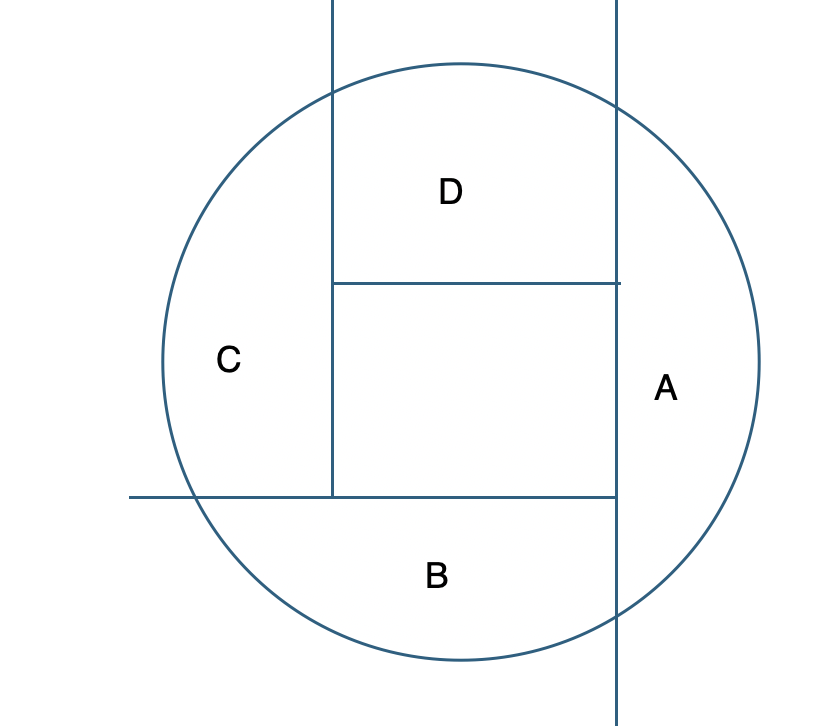
📌 题目名称
单位圆的顺序轴向切割等面积分配问题
📘 题目描述
在平面直角坐标系中,给定单位圆区域:
Ω={(x,y)∣x2+y2≤1}\Omega = \{(x,y)\mid x^2 + y^2 \le 1\}
该圆表示一个理想化“苹果横截面”,圆心对应果核位置。
✂️ 切割规则
在不允许切割线通过圆心(果核点 (0,0)(0,0) 被禁止作为任何切割线上的点)的条件下,依次进行四次轴向切割:
- 第1刀:直线 x=ax = a
- 第2刀:直线 y=by = b
- 第3刀:直线 x=cx = c
- 第4刀:直线 y=dy = d
其中:
a,c,b,d∈(−1,1),0∉{a,b,c,d}a,c,b,d \in (-1,1), \quad 0 \notin \{a,b,c,d\}
⚠️ 顺序切割规则(关键约束)
切割按顺序进行,每一刀仅作用于当前剩余区域:
- 第1刀在 Ω\Omega 上切割,生成区域 AA
- 第2刀在剩余区域上继续切割,生成区域 BB
- 第3刀在剩余区域上继续切割,生成区域 CC
- 第4刀在剩余区域上继续切割,生成区域 DD
- 剩余部分定义为中心区域 EE(果核区域)
📊 区域定义
设切割过程严格按照顺序进行,则得到五个互不重叠区域:
- AA:第一刀产生的外侧区域
- BB:第二刀在剩余区域产生的子区域
- CC:第三刀产生的子区域
- DD:第四刀产生的子区域
- EE:未被四刀划分出的中心残余区域(果核区域)
🎯 优化目标
寻找切割参数:
(a,b,c,d)(a,b,c,d)
使得四个可食用区域面积尽可能相等:
Area(A)≈Area(B)≈Area(C)≈Area(D)\mathrm{Area}(A) \approx \mathrm{Area}(B) \approx \mathrm{Area}(C) \approx \mathrm{Area}(D)
并且满足:
- 中心区域 EE 不参与等分
- 切割线不得经过圆心
- 顺序切割导致区域具有路径依赖性
📐 面积计算定义
单位圆上的任意竖切/横切弓形面积定义为:
F(t)=arccos(t)−t1−t2F(t)=\arccos(t)-t\sqrt{1-t^2}
则各区域面积由顺序切割诱导的非对称测度决定。
❗问题要求
(1)理论问题
是否存在解析解 (a,b,c,d)(a,b,c,d),使得:
Area(A)=Area(B)=Area(C)=Area(D)\mathrm{Area}(A)=\mathrm{Area}(B)=\mathrm{Area}(C)=\mathrm{Area}(D)
若存在,请用:
- π
- e
- √
等基础常数表示。
若不存在,请证明其不可解析表达性。
(2)数值问题(核心)
求一组数值解:
(a,b,c,d)(a,b,c,d)
使得:
max∣Area(i)−Area(j)∣→min(i,j∈{A,B,C,D})\max |\mathrm{Area}(i)-\mathrm{Area}(j)| \to \min \quad (i,j \in \{A,B,C,D\})
并给出:
- 四个区域面积
- 中心区域面积
- 误差估计
(3)扩展问题(选做)
- 若允许增加切割刀数 nn,最小化误差是否趋近于 0?
- 若切割顺序改变,最优解是否改变?
- 若推广至三维球体(苹果模型),结果如何变化?
📌 备注
该问题本质属于:
顺序依赖的几何测度分割优化问题
(Sequential Geometric Measure Partitioning Problem)
🧠 一句话总结版本(可用于论文摘要)
在单位圆内,通过四条不经过圆心的轴向直线进行顺序切割,使所得四个区域面积尽可能相等,并研究该顺序切割模型下的最优分割参数及其可解性。
Title
Sequential Axial Equal-Area Partitioning Problem in the Unit Disk
📘 Problem Statement
Consider the unit disk in the Cartesian plane:
Ω={(x,y)∣x2+y2≤1}\Omega = \{(x,y)\mid x^2 + y^2 \le 1\}
which represents an idealized circular object.
✂️ Cutting Rules
Four axis-aligned straight-line cuts are performed sequentially, under the constraint that no cutting line is allowed to pass through the origin (0,0)(0,0):
- First cut: x=ax = a
- Second cut: y=by = b
- Third cut: x=cx = c
- Fourth cut: y=dy = d
where:
a,b,c,d∈(−1,1),a,b,c,d≠0a,b,c,d \in (-1,1), \quad a,b,c,d \ne 0
⚠️ Sequential Constraint
The cuts are applied in order, and each cut acts only on the remaining region after previous cuts:
- The first cut partitions Ω\Omega into two parts.
- The second cut acts only on the remaining region after the first cut.
- The third cut acts only on the remaining region after the first two cuts.
- The fourth cut acts only on the remaining region after the first three cuts.
This induces path-dependent, non-symmetric partitioning.
📊 Region Definition
The procedure produces five disjoint regions:
- AA: region generated by the first cut
- BB: region generated by the second cut
- CC: region generated by the third cut
- DD: region generated by the fourth cut
- EE: remaining central region (unassigned core region)
🎯 Objective
Find parameters:
(a,b,c,d)(a,b,c,d)
such that the four outer regions satisfy approximate equal-area condition:
Area(A)≈Area(B)≈Area(C)≈Area(D)\mathrm{Area}(A) \approx \mathrm{Area}(B) \approx \mathrm{Area}(C) \approx \mathrm{Area}(D)
while:
- the central region EE is excluded from equalization
- no cut passes through the origin
- the partition is sequential and path-dependent
📐 Area Function
For a circular segment in the unit disk:
F(t)=arccos(t)−t1−t2F(t)=\arccos(t)-t\sqrt{1-t^2}
the region areas are governed by non-linear geometric measure induced by sequential truncation.
❗ Tasks
(1) Theoretical Question
Does there exist a closed-form solution for (a,b,c,d)(a,b,c,d) such that:
Area(A)=Area(B)=Area(C)=Area(D)\mathrm{Area}(A)=\mathrm{Area}(B)=\mathrm{Area}(C)=\mathrm{Area}(D)
If so, express it using standard constants such as:
- π\pi
- ee
- ⋅\sqrt{\cdot}
If not, provide a justification for non-closed-form solvability.
(2) Numerical Question
Compute a numerical solution for:
(a,b,c,d)(a,b,c,d)
that minimizes:
maxi,j∈{A,B,C,D}∣Area(i)−Area(j)∣\max_{i,j \in \{A,B,C,D\}} |\mathrm{Area}(i)-\mathrm{Area}(j)|
and report:
- the four region areas
- the central region area
- the approximation error
(3) Extension Question
- Does the approximation error tend to zero as the number of sequential cuts increases?
- How does the solution change if the cut order is permuted?
- What happens in the 3D analogue (unit sphere partitioning problem)?
📌 Remark
This problem belongs to:
Sequential geometric measure partitioning in convex domains with path-dependent constraints.